
Homepage

ACETADOTE® (acetylcysteine):
The Antidote for Acetaminophen Overdose.

ACETADOTE is an antidote for acetaminophen overdose indicated to prevent or lessen hepatic injury after ingestion of a potentially hepatotoxic quantity of acetaminophen in adults and pediatric patients who weigh 5 kg or greater with acute ingestion or from repeated supratherapeutic ingestion (RSI).

acetadote

ACETADOTE® (acetylcysteine)
Injection for intravenous use may be the right choice for:

Patient known to have ingested toxic doses of acetaminophen

Patient unable to swallow oral medication

Patient presenting with acetaminophen overdose

  • IV ACETADOTE is an EDTA-free N-acetylcysteine (NAC)
  • IV ACETADOTE contains no other preservatives
  • IV ACETADOTE has a 30-month shelf life

Cumberland is the manufacturer of ACETADOTE and an Authorized Generic distributed by Paddock/Perrigo. These formulations are the only EDTA-free IV acetylcysteine products available. The EDTA-free formulation also demonstrates stability that extends its shelf life to 30 months.

EDTA-Free and Preservative-Free Are Not the Same

You should be aware that there is a difference in IV acetylcysteine products available to you. Only two products are EDTA-free. All presentations of acetylcysteine have always been preservative-free. If you want to determine if a generic IV acetylcysteine supplied to your hospital contains EDTA, look for “disodium edetate” (EDTA) in the list of ingredients.

There are only 2 EDTA-free IV Acetylcysteine products.

ACETADOTE is an antidote for acetaminophen overdose indicated to prevent or lessen hepatic injury after ingestion of a potentially hepatotoxic quantity of acetaminophen. The critical ingestion-treatment interval for maximal protection against severe hepatic injury is between 0 and 8 hours. Efficacy diminishes progressively after 8 hours and treatment initiation between 15 and 24 hours post-ingestion of acetaminophen yields limited efficacy.

However, ACETADOTE does not appear to worsen the condition of patients and it should not be withheld if outside the 8 hour postingestion window, since the reported time of ingestion may not be correct.

Efficacy diminishes progressively after 8 hours, and treatment initiation between 15- and 24-hours post-ingestion of acetaminophen yields limited efficacy. However, ACETADOTE does not appear to worsen the condition of patients, and it should not be withheld, since the reported time of ingestion may not be correct.

Pre-Treatment Assessment Following Acute Ingestion:

Prior to initiating treatment with ACETADOTE, decide whether the three-bag or two-bag regimen will be used.

Obtain a plasma or serum sample to assay for acetaminophen concentration at least 4 hours after ingestion.

  • If the time of acetaminophen ingestion is unknown:
    • Administer a loading dose of ACETADOTE immediately.
    • Obtain an acetaminophen concentration to determine need for continued treatment.
  • If the acetaminophen concentration cannot be obtained (or is unavailable or uninterpretable) within the 8-hour time interval after acetaminophen ingestion or there is clinical evidence of acetaminophen toxicity:
    • Administer a loading dose of ACETADOTE immediately and continue treatment for a total of two doses over 20 hours or three doses over 21 hours.
  • If the patient presents more than 8 hours after ingestion and the time of acute acetaminophen ingestion is known:
    • Administer a loading dose of ACETADOTE immediately.
    • Obtain acetaminophen concentration to determine need for continued treatment
  • If the patient presents less than 8 hours after ingestion and the time of acute acetaminophen ingestion is known and the acetaminophen concentration is known:
    • Use the revised Rumack-Matthew nomogram to determine whether or not to initiate treatment with ACETADOTE.

Nomogram for Estimating Potential for Hepatotoxicity from Acute Acetaminophen Ingestion:

See Full Prescribing Information for instructions on how to use the nomogram to determine the need for dosing.

Preparation and Storage of Diluted Solution Prior to Administration:

  • Calculate the dose (mg) based on the patient’s weight in kg; multiple vials of ACETADOTE may be required.
    • ACETADOTE is hyperosmolar (2,600 mOsmol/L), therefore ACETADOTE must be diluted in the recommended volume of sterile water for injection, 0.45% sodium chloride injection, or 5% dextrose in water injection prior to intravenous administration. In general, 0.45% normal saline is the preferred diluent because it provides a more consistent osmolarity profile, reduces the amount of free water delivered to the patient, and better approximates physiologic fluids.

Examples of Acetylcysteine Concentration and Osmolarity in Three Solutions.

General Considerations for Selecting the Three-Bag or Two-Bag Regimen:

  • It is not known whether the two-bag regimen is comparable to the three-bag regimen in preventing hepatotoxicity.
  • Patients 40 kg or less should receive the three-bag regimen.
  • For patients weighing 41 kg or greater, the three-bag regimen may be preferred for those with early signs of severe liver injury or a large acetaminophen ingestion.

Recommended Dosage for Acute Acetaminophen Ingestion:

  • ACETADOTE is for intravenous administration only
  • Total dosage of ACETADOTE is 300 mg/kg given intravenously as either:
    • 3 separate doses infused over a total of 21 hours (see Table 2)
      OR
    • 2 separate doses infused over a total of 20 hours (see Table 3)

See Full Prescribing Information for recommendations for continuing ACETADOTE treatment after 21 hours.

Repeated Supratherapeutic Acetaminophen Ingestion:

  • Obtain acetaminophen concentration and other laboratory tests to guide treatment; revised Rumack-Matthew nomogram does not apply.
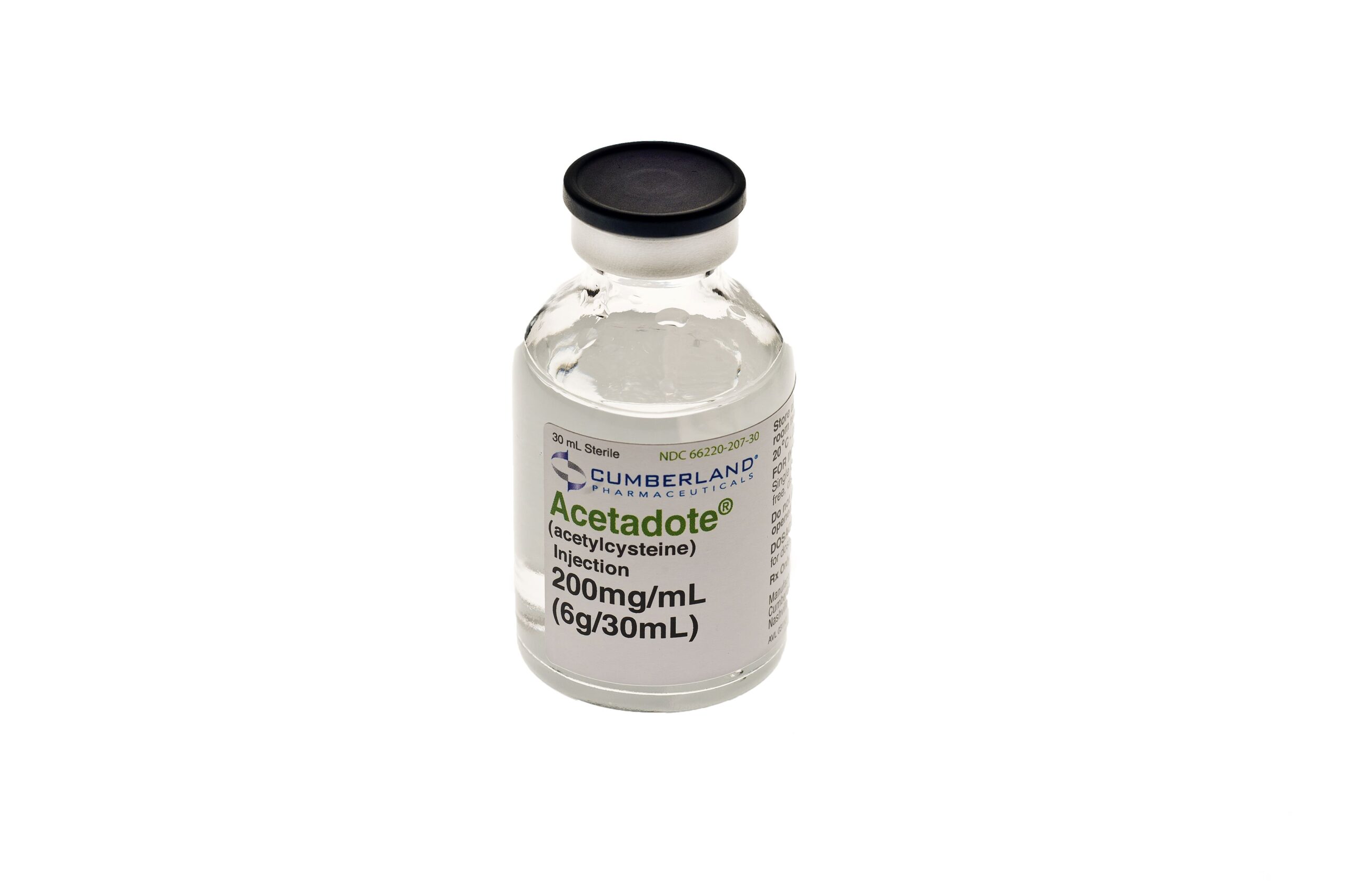
NDC Number: 66220-207-30

The Acetadote 2-Bag Dosing Regimen was Associated with:

Reduced treatment interrumptions or delays, occurring in 5% of patients versus 12% with the three-bag regimen3

Fewer adverse reactions, with a 4% non-allergic anaphylactoid reaction rate compared to 17% with the three-bag regimen3

Simplified dosing, with reduced administration complexity and opportunities for medication error3

Ordering Information

WHOLESALER

ORDER ENTRY NUMBER

Cardinal

4371894

McKesson

1620590

Cencora

10090970

Morris & Dickson

474445

To order Acetadote, please contact your Cumberland Customer Service at [email protected] or available through Cardinal, Cencora, Morris & Dickson and McKesson

Important Safety Information

INDICATION

ACETADOTE is an antidote for acetaminophen overdose indicated to prevent or lessen hepatic injury after ingestion of a potentially hepatotoxic quantity of acetaminophen in adults and pediatric patients who weigh 5 kg or greater with acute ingestion or from repeated supratherapeutic ingestion (RSI).

CONTRAINDICATION

ACETADOTE is contraindicated in patients with a previous hypersensitivity reaction to acetylcysteine.

WARNINGS AND PRECAUTIONS

Serious acute hypersensitivity reactions including rash, hypotension, wheezing, and/or shortness of breath have been observed in patients receiving intravenous acetylcysteine administration and occurred soon after initiation of infusion. Use with caution in patients with asthma or where there is a history of bronchospasm. Immediately discontinue infusion if a serious reaction occurs and initiate appropriate treatment. The total volume administered should be adjusted for patients less than 40 kg and for those requiring fluid restriction.

ADVERSE EVENTS

The most common adverse reactions (>2%) are rash, urticaria/facial flushing and pruritus.

References

1. ACETADOTE [Package Insert]. Nashville, TN: Cumberland Pharmaceuticals Inc.; July 2025.

2. Schmidt LE, et al. Fewer adverse effects associated with a modified two-bag intravenous acetylcysteine protocol compared to traditional three-bag regimen in paracetamol overdose. Clin Toxicol. 2018;56(11):1098-1103.